What is intelligence?
L’intelligenza è definita come la capacità di affrontare e risolvere con successo situazioni e problemi nuovi o sconosciuti.
Sono stati creati test per avere una misurazione matematica, il cosiddetto quoziente d’intelligenza che tanto successo ha avuto negli anni passati.
However, this type of measurement has also been heavily criticized for being limited to only one type of intelligence, and Howard Gardner, developmental psychologist and professor at the Harvard Graduate School of Education, developed a new theory of multiple intelligences.
The theory of multiple intelligences
In his 1987 book "Formae mentis. Saggio sulla pluralità dell’intelligenza," Howard Gardner explains how there are different forms of intelligence that make individuals unique and distinct. The IQ tests, so popular in those years, considered practically only one form.

The intelligences outlined by Gardner are:
- Linguistic intelligence (the ability to use clear and effective vocabulary);
- Logical-mathematical intelligence (the ability related to deductive reasoning, schematization, and logical chains);
- Musical intelligence (the ability to understand and organize sounds);
- Spatial intelligence (the ability to think with visual images and recall environmental details);
- Body-kinesthetic intelligence (mastery of the body, the ability to coordinate movements);
- Interpersonal intelligence (the ability to understand others, their needs, and fears. It helps succeed in relationships with others);
- Intrapersonal intelligence (the ability to know oneself, reflect on one's feelings, moods, and emotional states).
In addition to these 7, Gardner later added two more:
- Naturalistic intelligence (the ability to classify certain elements related to nature, categorize them, and identify connections);
- Existential intelligence (the ability to consciously reflect on major ethical and existential questions).
The theory of multiple intelligences has two important assumptions:
- tutti possiedono diverse intelligenze e la miscela di queste porta all’individualità delle persone;
- Each intelligence profile is different because everyone has different life experiences.
The evolution of the theory
In 1990, Peter Salovey and John D. Mayer first discussed emotional intelligence and its impact on behavior and relationships.
It is closely connected to the interpersonal and intrapersonal intelligence described by Gardner, but it was through Goleman, who in 1994 published the famous book "Emotional Intelligence: Why It Can Matter More Than IQ," that it gained widespread attention. In American organizations, it became an important evaluation element due to its impact on behavior and performance. In Italy, attention to this aspect in companies has only developed in the last decade.
Emotional intelligence is now a key factor for success within organizations that have become increasingly complex.
Confronting, collaborating, and cooperating within the team, listening, and considering the time and needs of individuals to achieve group goals is essential.
Some methodologies introduced more recently have further highlighted the importance of emotional intelligence skills:
- design thinking;
- agile methodology.
Emotional intelligence in agile methodology

The agile methodology was initially adopted in the software field, starting in 2000.
The goal is to deliver to the client, and frequently, higher quality software at a reduced cost. They thus devised an approach focused on the goal, which is less structured than traditional models.
It is all based on interactive loops. The core of the movement lies in having teams with diverse skills working together and interacting from the start of the project, continuously sharing new information, addressing the needs of each group, and the necessity to modify and review everything.
It involves the completion of micro-tasks to facilitate the achievement of the final result, usually composed of self-organized teams of few people, with the client being continuously involved in the development process.
The model used is incremental, where prototypes are created, presented to the client, discussed, and continuously reworked until finalization.
A continuous fine-tuning that reduces the risk of failure and increases the value of the final product.
The foundation of the agile methodology is responsibility, as self-organized teams overturn the classic, hierarchical pyramid style.
In addition, the quality of communication is essential, both face-to-face within the team and constantly with the client.
True listening to feedback, flexibility, respect, collaboration, humility, the ability to engage, connect, motivation, and optimism are fundamental ingredients, all aspects that make up the skills of emotional intelligence.
Emotional intelligence in design thinking
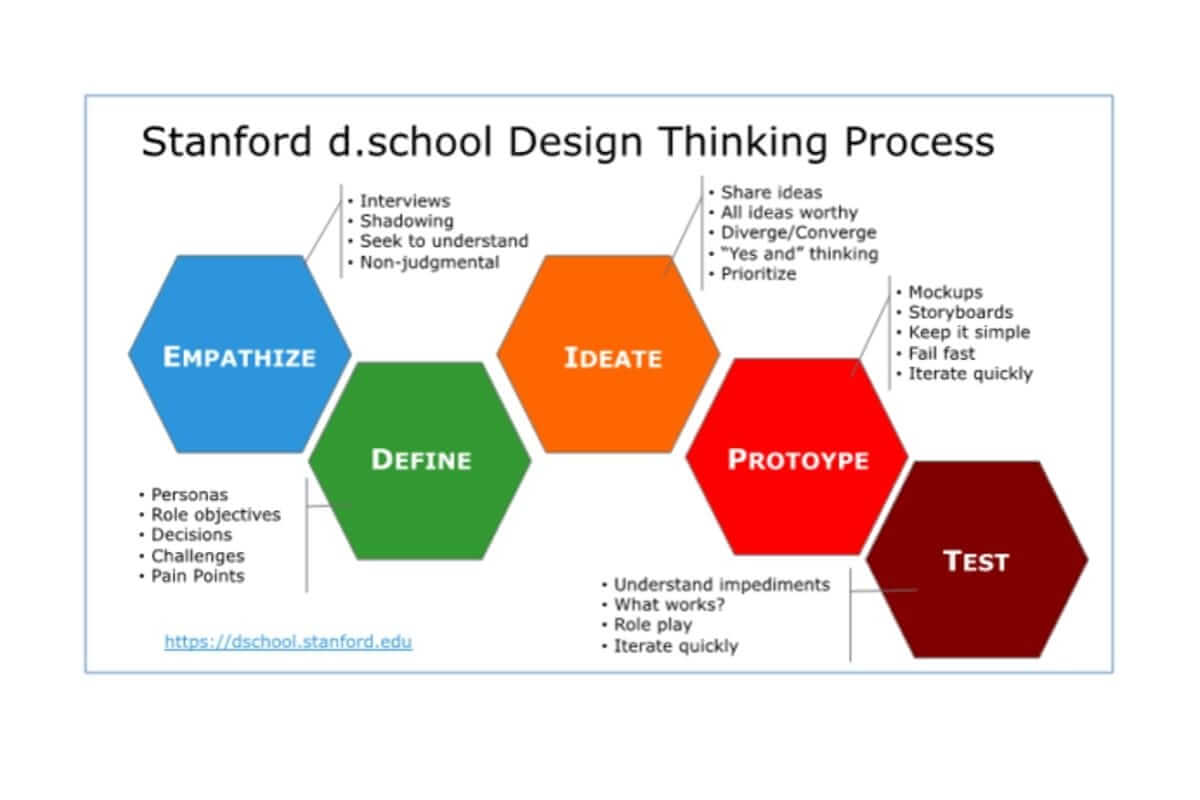
Design thinking stems from the idea that business should always work with a forward-looking perspective, starting from people's needs.
The focus of innovation has shifted from being product-centric to customer-centric and from marketing-centric to user experience-focused.
For many companies, it has become key to the development of effective strategies and organizational transformations.
Tim Brown, the CEO of IDEO, the company that coined the term design thinking, says:
Design thinking can be described as a discipline that uses the sensitivity and methods of designers to bring together people's needs with what is technologically feasible.
Thinking and acting like a designer brings together what is desirable from a human perspective with what is technologically and economically feasible. It also allows people who are not trained as creatives to use creative tools to tackle various types of challenges.
Design thinking aims to improve the future and seek to build new possibilities. Problem solving is about "eliminating something," while creating is about "bringing something into existence."
The various types of Design Thinking are:
- creative problem solving;
- sprint execution;
- creative confidence;
- innovation of meaning.
The philosophy of Design Thinking encourages, regardless of the type, to keep an open mind to consider any idea because:
il miglior modo di avere una buona idea è quello di avere tante idee”
– Linus Pauling –
In all these approaches, characteristics related to interpersonal intelligence and emotional intelligence are more important than ever: flexibility, self-confidence, optimism that allows one to continue moving forward with the belief that the goal will be achieved, enthusiasm and determination, listening, and direct communication.
Moura Quayle, author of *Designed Leadership*, says:
Great leaders have the ambition to lead "by design" with a sense of purpose and vision for the future. But still, few leaders have acquired the principles of design disciplines. The lesson learned from the world of design applied to management can transform them into visionary, collaborative, determined, creative, and responsible leaders.
Design Thinking creates the conditions for people to grow, develop, and express their full potential, ensuring that all types of businesses succeed.
Conclusions
The various forms of intelligence defined by Gardner are fundamental today in organizations, and depending on the sector and function, some are needed while others are not. However, interpersonal and intrapersonal intelligence, or more simply, emotional intelligence, will gain increasing importance as the number of organizations adopting new organizational models, such as the ones we’ve discussed, grows.